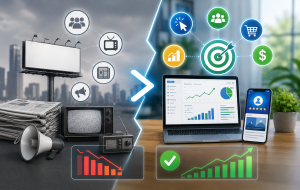
Businesses today want every marketing investment to produce meaningful results. Simply reaching a large audience is no longer enough. Companies now focus on attracting the right customers, generating qualified leads, and increasing sales while using their budgets wisely. This is why Performance Marketing has become one of the most preferred digital marketing strategies.
Unlike Traditional Marketing, which often measures success through estimated audience reach, Performance Marketing focuses on real, measurable outcomes such as clicks, enquiries, conversions, and sales. This allows businesses to make informed decisions and improve their campaigns continuously.
What Is Performance Marketing?
Performance Marketing is a results-driven digital marketing approach where businesses pay based on specific actions. These actions may include website visits, lead generation, online purchases, app downloads, or customer enquiries.
Since every campaign can be tracked, businesses gain valuable insights into customer behaviour and marketing performance.
What Is Traditional Marketing?
Traditional Marketing includes offline promotional methods such as television commercials, newspapers, magazines, radio advertisements, brochures, billboards, and direct mail.
While these methods can increase brand awareness, it is often difficult to measure exactly how many people became customers because of a specific advertisement.
Why Performance Marketing Is More Effective
Delivers Measurable Results
One of the biggest strengths of Performance Marketing is transparency. Businesses can monitor campaign performance through data such as website traffic, conversions, customer enquiries, and return on investment.
This helps marketers understand which strategies are delivering the best results.
Targets the Right Audience
Instead of promoting products to a broad audience, Performance Marketing allows businesses to reach people based on location, interests, online behaviour, and search intent.
Targeted marketing improves engagement and increases the likelihood of generating qualified customers.
Makes Better Use of Marketing Budgets
Every business wants to invest wisely. Performance-based campaigns allow businesses to increase spending on successful advertisements while improving or stopping campaigns that produce weaker results.
This flexible approach helps maximize Return on Investment (ROI).
Supports Continuous Improvement
Digital campaigns can be optimized while they are running. Businesses can test different headlines, visuals, audience groups, and landing pages to improve overall campaign performance.
This ongoing optimization leads to stronger long-term results.
Provides Valuable Customer Insights
Campaign analytics help businesses understand customer preferences, browsing behaviour, purchasing decisions, and engagement patterns.
These insights support better marketing decisions and improve future customer experiences.
Can Traditional Marketing Still Be Useful?
Yes. Traditional Marketing can still help build local brand awareness and reach audiences who may not spend much time online. For some businesses, combining traditional and digital marketing creates a balanced marketing strategy.
However, businesses looking for measurable growth often rely more heavily on Performance Marketing because of its flexibility and data-driven approach.
Tips for Better Performance Marketing Results
- Set clear marketing goals before launching campaigns.
- Understand your target audience.
- Create engaging and relevant advertisements.
- Optimize your landing pages for conversions.
- Monitor campaign performance regularly.
- Test different marketing messages.
- Improve campaigns using performance data.
Conclusion
Performance Marketing has changed the way businesses approach advertising. Instead of relying on assumptions, it allows companies to make decisions based on measurable performance and real customer behaviour.
By combining audience targeting, campaign optimization, and continuous analysis, businesses can improve marketing efficiency, attract qualified customers, and achieve sustainable long-term growth. A customer-focused strategy supported by reliable data helps businesses build stronger relationships and achieve better results in today’s competitive marketplace.
Frequently Asked Questions (FAQs)
1. What is Performance Marketing?
Performance Marketing is a digital marketing strategy where businesses measure success through actions such as clicks, leads, conversions, or sales.
2. Why is Performance Marketing better than Traditional Marketing?
It provides measurable results, better audience targeting, flexible budget management, and continuous campaign optimization.
3. What is the biggest advantage of Performance Marketing?
The biggest advantage is the ability to track campaign performance and improve marketing decisions using real data.
4. Can small businesses use Performance Marketing?
Yes. Small businesses can start with affordable budgets, target specific audiences, and scale campaigns as they grow.
5. Which channels are used in Performance Marketing?
Popular channels include Google Ads, Social Media Advertising, Search Engine Marketing (SEM), Email Marketing, affiliate marketing, and display advertising.
6. Does Performance Marketing help increase sales?
Yes. By targeting the right audience and optimizing campaigns, businesses can generate qualified leads and improve conversion rates.
7. Is Traditional Marketing still useful?
Yes. It can support local branding and offline awareness, but it usually offers fewer measurement options than digital marketing.
8. What metrics are important in Performance Marketing?
Key metrics include Click-Through Rate (CTR), Conversion Rate, Cost Per Click (CPC), Cost Per Acquisition (CPA), and Return on Investment (ROI).
9. How quickly can Performance Marketing deliver results?
Paid campaigns often begin generating measurable results within a few days, while ongoing optimization improves long-term performance.
10. Can Performance Marketing work together with SEO?
Yes. Combining Performance Marketing, SEO, Content Marketing, Social Media Marketing, and Email Marketing creates a stronger digital marketing strategy that supports both immediate and long-term business growth.